I am a final-year PhD researcher at King’s College London, supervised by Prof. Andrew J. Reader and Prof. Andrew P. King. My research focuses on generative modelling, inverse problems and probabilistic machine learning, with applications to medical image reconstruction. I expect to submit my PhD in September 2027.
I am particularly interested in developing methods for conditioning generative models on measurements, efficient conditional sampling, statistical data consistency, and understanding how learned priors and model mismatch affect inverse problem solutions.
My first- and co-first-authored research has appeared at ICLR, ICML, MICCAI and IEEE Transactions on Medical Imaging. In 2025, I received my faculty’s PGR Research Excellence Prize.
Before my PhD, I studied Mathematics and Computer Science at the University of Oxford, graduating with a First-Class Integrated Master’s degree.
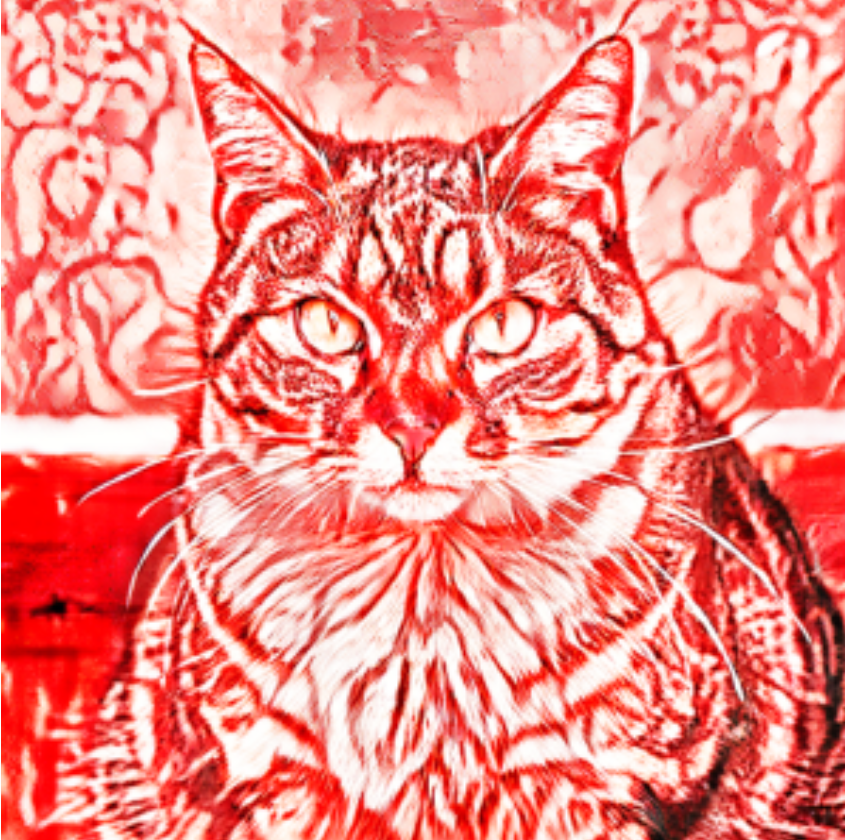
Flow-based generative models provide strong unconditional priors for inverse problems, but guiding their dynamics for conditional generation remains challenging. Recent work casts training-free conditional generation in flow models as an optimal control problem; however, solving the resulting trajectory optimisation is computationally and memory intensive, requiring differentiation through the flow dynamics or adjoint solves. We propose MPC-Flow, a model predictive control framework that formulates inverse problem solving with flow-based generative models as a sequence of control sub-problems, enabling practical optimal control-based guidance at inference time. We provide theoretical analysis linking MPC-Flow to the underlying optimal control objective and show how different algorithmic choices yield a spectrum of guidance algorithms, including regimes that avoid backpropagation through the generative model trajectory. We evaluate MPC-Flow on benchmark image restoration tasks, spanning linear and non-linear settings such as in-painting, deblurring, and super-resolution, and demonstrate strong performance and scalability to massive state-of-the-art architectures via training-free guidance of FLUX.2 (32B) in a quantised setting on consumer hardware.
We formulate conditional generation with flow models as a sequence of model predictive control problems, enabling efficient guidance without optimising the entire trajectory.
Conference Paper
Distributional Consistency Loss: Beyond Pointwise Data Terms in Inverse Problems
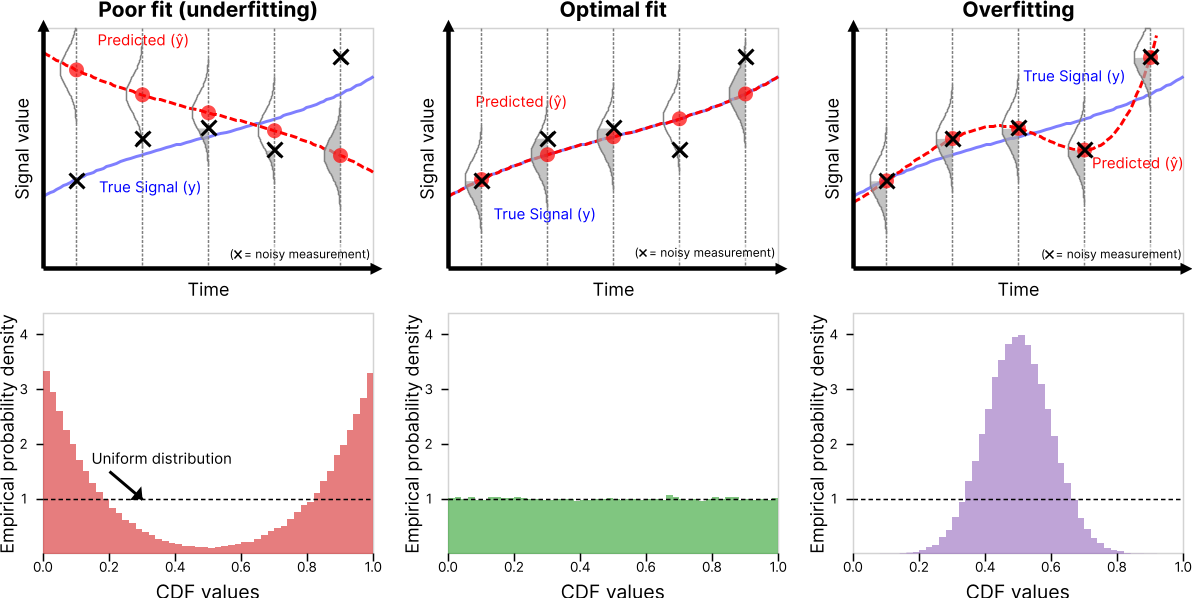
Recovering true signals from noisy measurements is a central challenge in inverse problems spanning medical imaging, geophysics, and signal processing. Current solutions nearly always balance prior assumptions regarding the true signal (regularization) with agreement to noisy measured data (data-fidelity). Conventional data-fidelity loss functions, such as mean-squared error (MSE) or negative log-likelihood, seek pointwise agreement with noisy measurements, often leading to overfitting to noise. In this work, we instead evaluate data-fidelity collectively by testing whether the observed measurements are statistically consistent with the noise distributions implied by the current estimate. We adopt this aggregated perspective and introduce distributional consistency (DC) loss, a data-fidelity objective that replaces pointwise matching with distribution-level calibration. DC loss acts as a direct and practical plug-in replacement for standard data consistency terms: i) it is compatible with modern unsupervised regularizers that operate without paired measurement–ground-truth data, ii) it is optimized in the same way as traditional losses, and iii) it avoids overfitting to measurement noise without early stopping or the use of priors. Its scope naturally fits many practical inverse problems where the measurement-noise distribution is known and where the measured dataset consists of many independent noisy values. We demonstrate efficacy in two key example application areas: i) in image denoising with deep image prior, using DC instead of MSE loss removes the need for early stopping and achieves higher PSNR; ii) in medical image reconstruction from Poisson-noisy data, DC loss reduces artifacts in highly-iterated reconstructions and enhances the efficacy of hand-crafted regularization. These results position DC loss as a statistically grounded, performance-enhancing alternative to conventional fidelity losses for an important class of unsupervised noise-dominated inverse problems.
A new data-fidelity loss improves the quality and stability of inverse-problem reconstructions by matching the noise distribution instead of individual measurements.
Journal Paper
Likelihood-Scheduled Score-Based Generative Modeling for Fully 3D PET Image Reconstruction
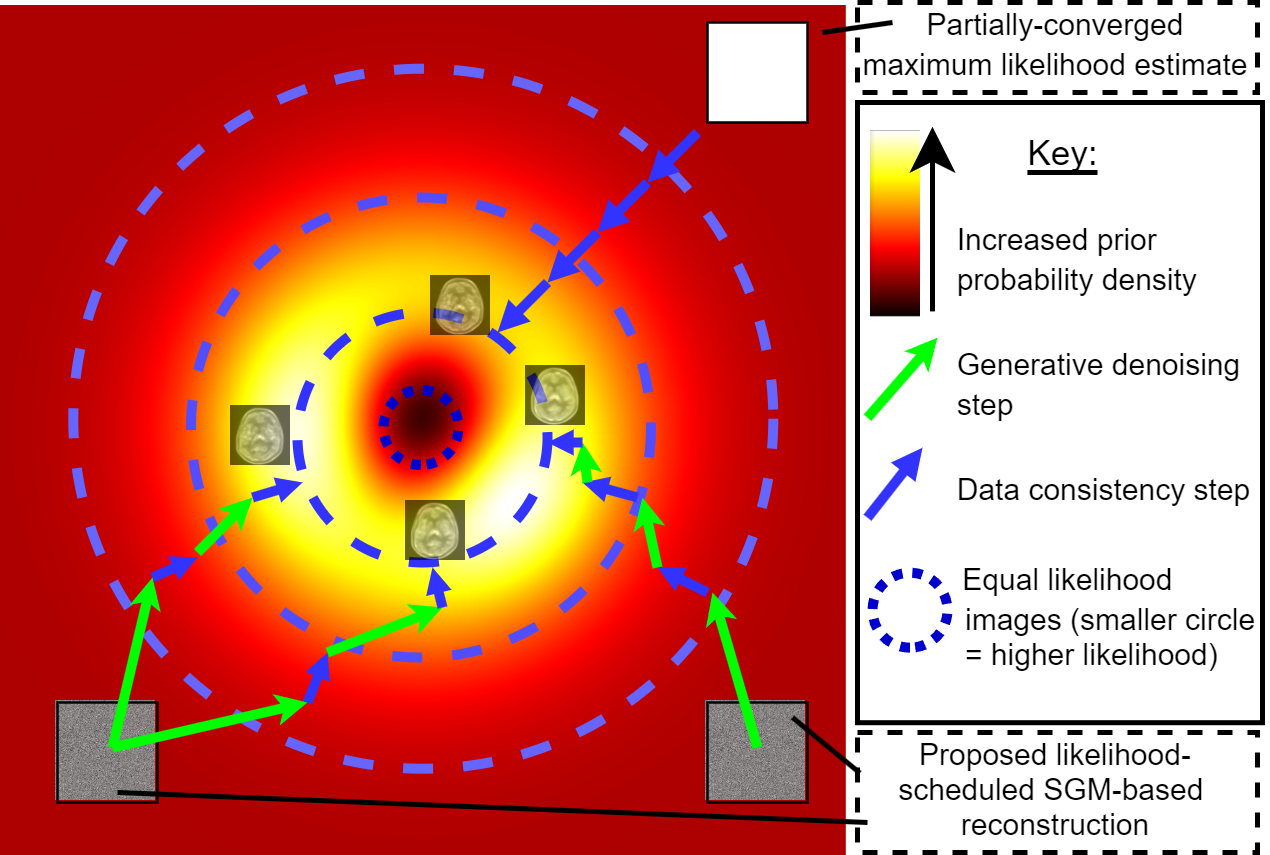
Medical image reconstruction with pretrained score-based generative models (SGMs) has advantages over other existing state-of-the-art deep-learned reconstruction methods, including improved resilience to different scanner setups and advanced image distribution modeling. SGM-based reconstruction has recently been applied to simulated positron emission tomography (PET) datasets, showing improved contrast recovery for out-of-distribution lesions relative to the state-of-the-art. However, existing methods for SGM-based reconstruction from PET data suffer from slow reconstruction, burdensome hyperparameter tuning and slice inconsistency effects (in 3D). In this work, we propose a practical methodology for fully 3D reconstruction that accelerates reconstruction and reduces the number of critical hyperparameters by matching the likelihood of an SGM’s reverse diffusion process to a current iterate of the maximum-likelihood expectation maximization algorithm. Using the example of low-count reconstruction from simulated [18F]DPA-714 datasets, we show our methodology can match or improve on the NRMSE and SSIM of existing state-of-the-art SGM-based PET reconstruction while reducing reconstruction time and the need for hyperparameter tuning. We evaluate our methodology against state-of-the-art supervised and conventional reconstruction algorithms. Finally, we demonstrate a first-ever implementation of SGM-based reconstruction for real 3D PET data, specifically [18F]DPA-714 data, where we integrate perpendicular pre-trained SGMs to eliminate slice inconsistency issues.
We propose specifying the desired image-data agreement in advance and derive a diffusion-based method to reconstruct high-quality medical images that meet this target likelihood.
Conference Paper
Supervised Diffusion-Model-Based PET Image Reconstruction
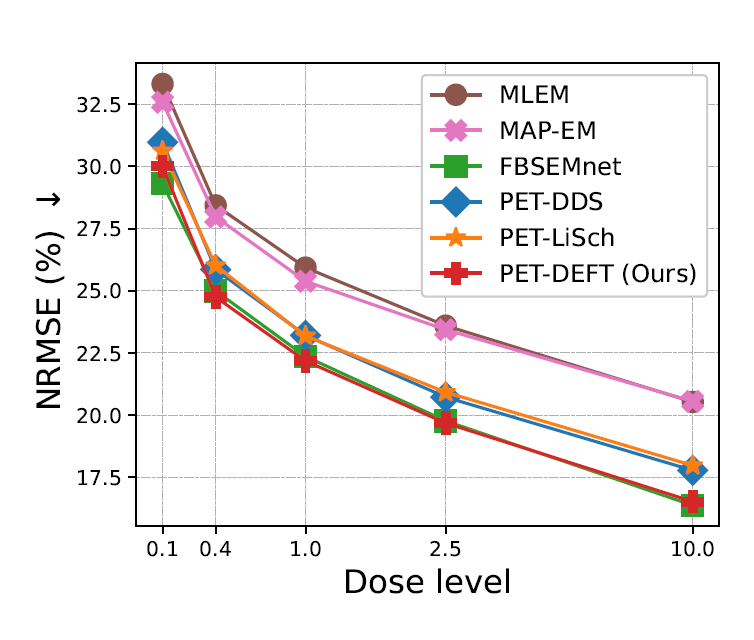
Diffusion models (DMs) have recently been introduced as a regularizing prior for PET image reconstruction, integrating DMs trained on high-quality PET images with unsupervised schemes that condition on measured data. While these approaches have potential generalization advantages due to their independence from the scanner geometry and the injected activity level, they forgo the opportunity to explicitly model the interaction between the DM prior and noisy measurement data, potentially limiting reconstruction accuracy. To address this, we propose a supervised DM-based algorithm for PET reconstruction. Our method enforces the non-negativity of PET’s Poisson likelihood model and accommodates the wide intensity range of PET images. Through experiments on realistic brain PET phantoms, we demonstrate that our approach outperforms or matches state-of-the-art deep learning-based methods quantitatively across a range of dose levels. We further conduct ablation studies to demonstrate the benefits of the proposed components in our model, as well as its dependence on training data, parameter count, and number of diffusion steps. Additionally, we show that our approach enables more accurate posterior sampling than unsupervised DM-based methods, suggesting improved uncertainty estimation. Finally, we extend our methodology to a practical approach for fully 3D PET and present example results from real [18F]FDG brain PET data.
We train a diffusion model to condition directly on PET measurements, improving reconstruction accuracy and posterior sampling with an approach that scales to real 3D data.
I have reviewed for ICLR, Nature Communications, Medical Image Analysis, IEEE Transactions on Medical Imaging, IEEE Transactions on Computational Imaging and Pattern Recognition.